Abstract
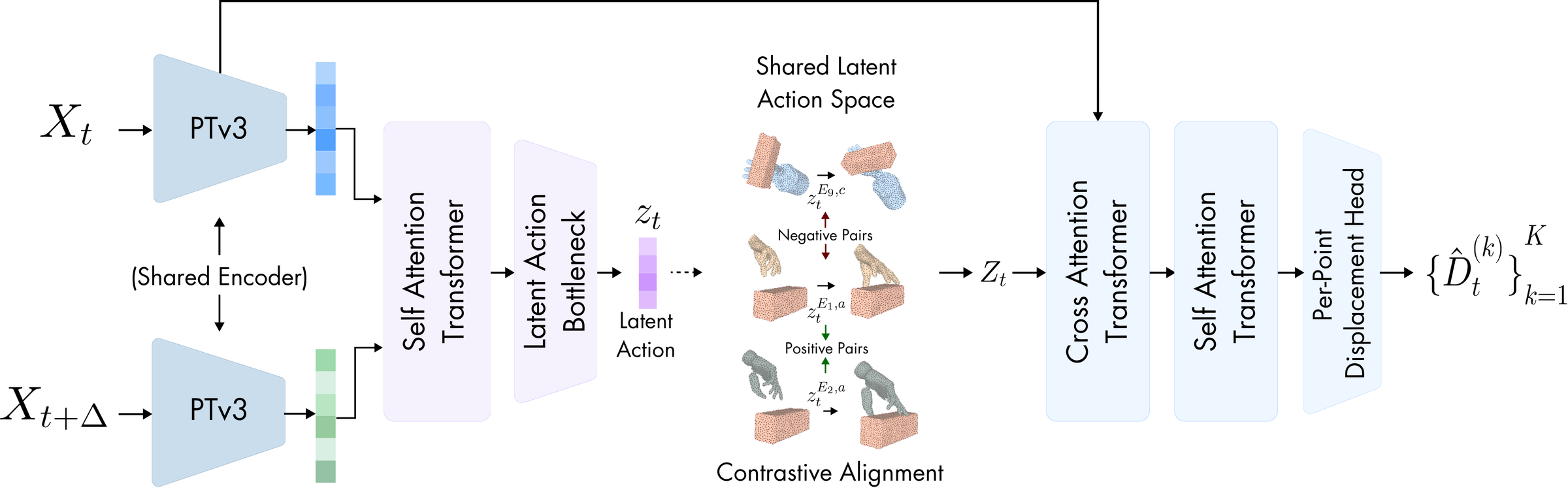
World models facilitate planning and control in robotic manipulation by enabling agents to anticipate the consequences of their actions. However, they typically rely on action-labelled interaction data that is costly to acquire and difficult to scale. These models are also often tied to the specific embodiment they were trained on, limiting transferability to previously unseen robot morphologies. We introduce a 3D latent-action world model that learns continuous action representations directly from point-cloud observations of retargeted human manipulation demonstrations. A contrastive objective is used to encourage consistent representations of motion across embodiments. The resulting unified latent action space serves directly as the search space for model-predictive control, where sampled latent actions condition particle-based future predictions. Executable robot commands are then recovered from the predicted geometric motion without requiring an embodiment-specific action decoder. Through extensive evaluations, we demonstrate that the learned latent actions exhibit controllable and compositional motion, transfer to unseen robot embodiments, and support zero-shot manipulation with unseen gripper geometries. Following task-agnostic adaptation, our model achieves 90%, 92%, and 60% success on reaching, grasping, and placing, respectively, compared with DexWM’s reported 72%, 58%, and 28%. Finally, we demonstrate zero-shot real-world manipulation with an unseen dexterous hand, achieving an 86% success rate across 50 trials on five diverse tasks involving pushing, grasping, and lifting everyday objects. These results highlight the potential of geometry-grounded latent actions as a unified, transferable interface for world-model-based robotic manipulation.
Method
Data
Human demonstrations retargeted to eight robot hands and represented as 3D particles: the same motion, in nine embodiments.
9 embodiments92 demonstration sequences41,094 training transitions
Particles
Point flow
Explore the demonstrations in 3D
One demonstration, several embodiments. Pick a demonstration and a hand; the coloured trails show how each particle has moved over the last second.
Drag to orbit · scroll to zoom · right-drag to pan · retargeted training demonstrations (ground truth)
Results
Unseen Grippers RoboSuite · zero-shot, no fine-tuning
10 trials per task
Dexterous Manipulation RoboCasa · task-agnostic adaptation
50 episodes per task
Real World Sharpa Wave hand · zero-shot, no fine-tuning
10 trials per task
Success rate (%). DexWM: results reported by its authors. PointWorld was not evaluated on the two pushing tasks.
Latent Conditioning End-point error of moving particles · lower is better
H2O validation split
Planning and Execution RoboCasa · same world model, episodes and planning budget
20 episodes per task
Left: mean error over the five predicted steps (mm) when the forward model is given the correct latent actions, or zeroed, fixed or shuffled ones; no motion assumes zero displacement. Right: success rate (%) when planning searches latent actions or native robot actions, executed through inverse kinematics on the predicted points, directly, or through a learned latent-to-action decoder.
Simulation
Dexterous Manipulation RoboCasa · Franka arm with Allegro hand · 2× speed
Reach
Gripper Manipulation RoboSuite · Franka Panda, grippers unseen during training
Reach + Push PuckWiping gripper
Real World
Dexterous Manipulation UR7e arm with Sharpa Wave hand · unseen during training, no fine-tuning
Grasp and Lift Cup
8× speed
Citation
@misc{mohan2026dexlatentworld3dcrossembodimentlatent,
      title={DexLatentWorld: 3D Cross-Embodiment Latent Action World Models for Zero-Shot Robotic Manipulation},
      author={Vinay Udit Mohan and Xuchuan Huang and Rolandos Alexandros Potamias},
      year={2026},
      eprint={2611.30907},
      archivePrefix={arXiv},
      primaryClass={cs.RO},
      url={https://arxiv.org/abs/2611.30907},
}